 Modern art: refers to artistic works produced during the period extending roughly from the 1860s to the 1970s. The term is usually associated with art in which the traditions of the past have been thrown aside in a spirit of experimentation. Modern artists experimented with new ways of seeing and with fresh ideas about the nature of materials and functions of art. A tendency toward abstraction is characteristic of much modern art.
 13-A Walker Evans, Brooklyn Bridge, New York, 1929
- Would you recognize the image in this photograph as a bridge if it were not titled? Is this the shape you visualize when they think of a bridge?
- Why not? It’s from a different viewpoint than the one from which we usually see a bridge.
- When most artists create a picture of a bridge, what view do they show of it? Most photographs show a side view. (Below is a print of the bridge from 1883, when the bridge was completed. Notice how the perspective is very different.)

- Where was the camera when this photograph was taken? It was down low, looking up at one of the bridge’s two towers.
- Locate the point to which all the cable lines seem to lead. It is near the top center of the bridge tower.
- Is this point centered in the photograph? No, it isn’t.
- Is the balance in this picture symmetrical or asymmetrical? It is asymmetrical.
- Have you ever seen windows that were shaped like the arches on this bridge. Where did you see these? These pointed arches resemble Gothic arches usually found in medieval churches and architecture. Students might have seen pointed arches in a church.
- Gothic cathedrals were the great engineering achievements of medieval Europe. What might the presence of Gothic arches in the Brooklyn Bridge have symbolized? The reference to Gothic architecture might have symbolized that the Brooklyn Bridge was an American marvel of engineering, equivalent to the Gothic cathedrals of Europe.
- Evans wanted his photographs to show the national character of America. How does this photograph satisfy his aim? The Brooklyn Bridge, in America’s largest city, was a structure that Americans were proud of. It was a modern feat of engineering and architecture. Evans’s photograph shows the beauty of a structure that thousands of Americans used every day.
- Until the late nineteenth and early twentieth centuries, photography was primarily a means of documentation and was not considered art. The photographer who took this picture considered photography to be an art form. Do you agree with him? Use this photograph to support your reasoning.
- Evans used a modern medium (photography) to create a modern image of a famous structure. When he had studied art in Paris, he saw modern European art that featured abstract, simplified forms. How is this photograph like abstract modern art? Its unconventional viewpoint makes the shape of the bridge seem abstract and not easily recognizable. The stark dark shape against the plain light background with the explosion of lines leading to it makes it seem like a contemporary geometric composition.


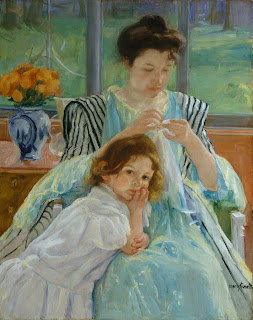 Young Mother Sewing, 1900; Oil on canvas; 36 3/8 x 29 in. (92.4 x 73.7 cm)During the 1890s Cassatt narrowed the range of her subjects to mothers or nurses caring for children, and children alone. These themes reflected her affection for her nieces and nephews and her friends' children as well as her contemporaries' concern with motherhood and child rearing. Set in the conservatory of Cassatt's seventeenth-century manor house near Le Mesnil-Théribus, Oise, this painting depicts two of her favorite unrelated models in the roles of mother and child. Louisine Havemeyer, who purchased the painting in 1901, remarked on the truthfulness of its narrative: "Look at that little child that has just thrown herself against her mother's knee, regardless of the result and oblivious to the fact that she could disturb ‘her mamma.' And she is quite right . . . Mamma simply draws back a bit and continues to sew."


